With the ability to deliver clean, safe, and reliable energy, nuclear energy is increasingly recognized as a critical solution for meeting rising global power demand while bringing new firm generation to the grid.
Advanced nuclear technologies like X-energy’s Xe-100 are designed specifically to address modern energy challenges: grid reliability, industrial applications, water scarcity, and rapid load growth from electrification and data centers.
Overview of Nuclear Energy and How It Works
Nuclear energy is a clean and efficient way to produce power, and today accounts for almost 20% of all U.S. electricity generation. While the technology itself can appear complex, the fundamentals are simple and comparable to most forms of energy generation. Fuel made of low-enriched uranium undergoes nuclear fission, splitting atoms to generate heat. In a traditional power plant, this heat is created by burning fuels like coal, oil, or gas. This heat is typically used to create steam, which can be used for high-temperature industrial processes or to power turbines that generate electricity.
Advantages of Nuclear Energy
1. Clean
Nuclear energy is a critical asset in the global clean energy transition, providing safe baseload generation for the communities it serves without producing carbon emissions. In today’s energy landscape, nuclear is a clean alternative to traditional power generation that enables end users to meet rapidly growing energy demand from electrification and advanced technologies while also reducing their emissions.
Advanced nuclear solutions like the Xe-100 extend this advantage by addressing practical constraints that can limit other clean energy technologies. The Xe-100 delivers clean energy with:
- Minimal land requirements: A four-unit Xe-100 plant requires roughly 26 acres, up to 75× less land than wind or solar installations delivering equivalent firm capacity. This compact footprint supports greater flexibility in siting and preserves land for other economic or community uses.
- Reduced water consumption: The Xe-100’s high-temperature gas-cooled reactor design uses helium rather than water as its primary coolant, requiring minimal water during normal operation. This enables deployment in water-scarce regions and at industrial sites where traditional cooling infrastructure is impractical.
- Industrial applications: The Xe-100 can deliver high-temperature steam up to 565 °C, enabling clean energy supply for industrial processes that require continuous thermal input.
2. Safe
Nuclear energy is among the safest forms of energy generation ever deployed, supported by decades of commercial operation, a strong safety performance record worldwide, and a robust industry-wide safety culture that prioritizes safe operations above all else.
Advanced reactors like the Xe-100 build on this foundation by embedding safety directly into key design principles, leveraging next-generation fuel technology and basic physics to reduce reliance on active controls, external backup power, or operator intervention. Core safety characteristics of the Xe-100 include:
Core safety characteristics of the Xe-100 include:
- TRISO Fuel: The Xe-100 uses TRISO (TRi-structural ISOtropic) particle fuel, described by the Department of Energy as “the most robust nuclear fuel on Earth”. Each TRISO particle is roughly the size of a poppy seed, and coated with microscopic particle layers that act as a containment system capable of retaining radioactive materials under any credible accident or operating scenario.
- Passive Safety Systems: In unforeseen circumstances, the Xe-100 is designed to safely shut itself down without requiring external backup power or operator intervention. The reactor’s negative temperature coefficient means that as core temperature rises, the fission reaction naturally slows, leveraging basic physics to ensure safety by design.
- Low Power Density: The Xe-100’s pebble-bed design distributes fuel throughout a large graphite core, resulting in significantly lower power density than traditional reactors. This inherent characteristic limits peak temperatures and provides greater thermal inertia, giving operators more time to respond to any unexpected operational changes.
3. Reliable
Nuclear energy is one of the most reliable and consistent sources of energy. The U.S. Energy Information Administration states that nuclear has the highest capacity factor of any other energy source—meaning nuclear facilities can produce reliable and secure power more than 94% of the time, compared to other energy sources like natural gas (capacity factor approximately 56.6%) or solar power (approximately 24.9%), nuclear. Rising energy consumption and the increased focus on decarbonization create a significant requirement for nuclear energy’s carbon-free, always-on generation.
Nuclear power facilities can run continuously for long periods of time without needing frequent maintenance or refueling. As a result, they can consistently supply the grid and the communities they servce with uninterrupted electricity. Because of this, grid managers can plan and manage the supply of electricity more effectively.
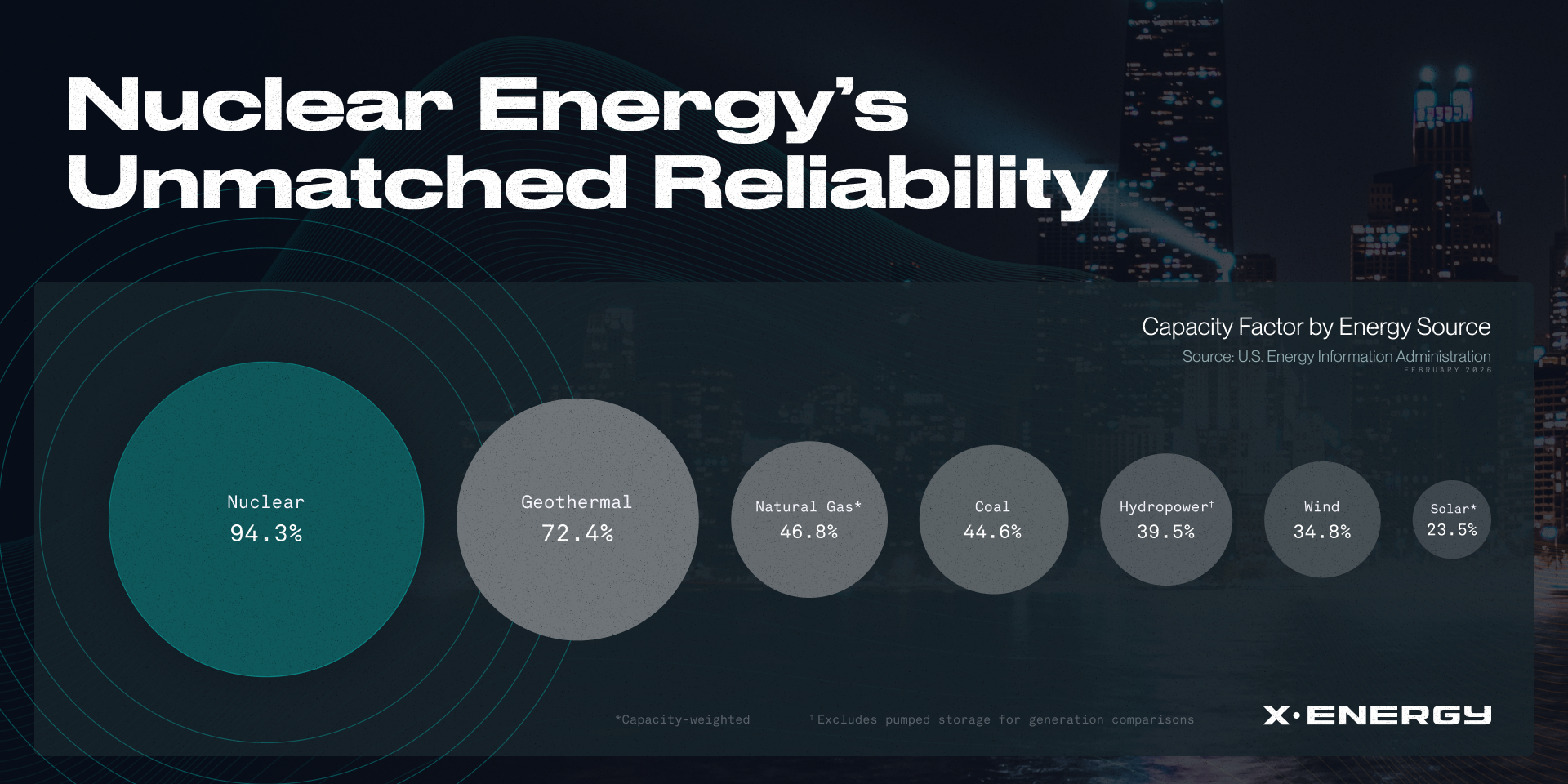
Nuclear’s ability to provide clean baseload capacity is also increasingly important as renewable energy sources such as wind and solar continue to become a greater share of the global energy supply. While important assets, renewables face inherent limitations in providing consistent baseload power due to their intermittency. Wind doesn’t always blow, and the sun doesn’t always shine—creating periods where generation drops significantly or stops entirely.
Advanced small modular reactors like the Xe-100 complement renewables by providing firm, dispatchable power with load-following capabilities. The Xe-100 has a target capacity factor of 95%, and is designed to ramp up or ramp down based on customer and grid needs, filling gaps when renewable generation is low and scaling back during periods of high renewable output. This flexibility helps stabilize grids increasingly supplied by variable sources.
Comparing Advanced SMRs to Traditional Nuclear Reactors
Advanced small modular reactors offer distinct advantages in construction and safety compared to reactor designs operating today. Conventional, large-scale nuclear facilities have high upfront capital costs due to their large size, substantial containment structures, and longer construction times. Advanced SMRs are largely factory built and road-shippable, which reduces on-site work and results in better cost predictability and more efficient quality control.
From a safety perspective, advanced SMRs have lower reactor power density and a self-regulating core design. This means that the core is designed to shut down if cooling stops and is intended to prevent the reactor from melting under foreseeable adverse conditions without action by the operator. Because of this, the emergency planning zone for advanced SMRs can be at the site boundary, allowing the technology to be located closer to population centers and industrial facilities that require process heat.
Central to this safety profile is the Xe-100’s use of TRISO fuel, replacing uranium pellets and fuel rods with graphite pebbles, each containing thousands of uranium kernels surrounded by ceramic and carbon coating layers that act as a microscopic containment system.
| Feature | Traditional Large Nuclear | Xe-100 Advanced SMR |
| Fuel | Pellets and Fuel Rods | TRISO fuel pebbles |
| Construction Method | On-site custom build | Factory-built modules |
| Power Output per Unit | 1,000+ MW | 80 MW (scalable) |
| Land Footprint (4-unit) | 40+ acres | ~26 acres for a 4-unit/320Mwe plant |
| Emergency Planning Zone | 10+ miles | Site boundary |
What Differentiates HTGRs Like the Xe-100 From Other SMRs?
High temperature gas reactors (HTGRs) like X-energy’s Xe-100 are a significant advancement in fission technology, fundamentally rethinking basic design principles to engineer each system of the reactor around intrinsic safety characteristics, proven material properties, and high-temperature performance. Together, this approach helps enables a simpler design, and a wider range of applications when compared to both conventional large reactors, and other SMR technologies.
The defining characteristic of HTGRs is right in the name: high-temperature operation. The Xe-100 can deliver process steam at temperatures up to 565°C—far higher than conventional light water reactors, which typically operate around 300°C. This high-temperature capability enables the Xe-100 to extend beyond electricity generation into industrial applications. Heavy industries such as chemicals, oil refining, steel production, cement manufacturing, and mining require immense amounts of continuous, high-temperature heat and steam to power their operations and industrial equipment.
A prime example of advanced nuclear’s potential in heavy industry is unfolding at Dow’s UCC Seadrift Operations on the Texas Gulf Coast. X-energy’s proposed four-unit Xe-100 plant would provide both electricity and high-temperature industrial steam to power Dow’s chemical manufacturing operations. Supported by the U.S. Department of Energy’s Advanced Reactor Demonstration Program (ARDP), this project aims to make Seadrift the first industrial facility in North America powered by nuclear energy—and demonstrate how clean, safe, reliable nuclear energy can support major industrial operations without compromising on output, reliability, or emissions.
Workforce, Jobs, and the Future of Nuclear Careers
Nuclear power plants can operate for over 60 years, creating long-lasting, high-paying jobs for people from a range of fields and educational backgrounds. Undertaking a nuclear power program therefore represents a long-term investment in human capital, and X-energy is making that investment real through operational training centers and strategic workforce partnerships.
X-energy’s workforce infrastructure is already taking shape:
- Maryland: X-energy opened its first Plant Support Center in March 2023, a 10,447-square-foot state-of-the-art facility designed to train up to 52 operators at one time. The PSC features a full-scale Xe-100 plant control room simulator, Reactor Protection System prototype, and virtual reality training environments. This facility is actively preparing the first cohort of operators for deployment at Dow’s Seadrift facility.
- Washington State: Energy Northwest, Columbia Basin College, and WSU Tri-Cities recently unveiled the second Xe-100 training simulator in the United States. Funded through the U.S.Department of Energy’s Community Capacity Building Grant Program, this educational simulator provides hands-on experience for students in clean energy and nuclear technology programs—helping to build the local workforce pipeline for the Cascade Advanced Energy Facility.
- United Kingdom: Centrica and X-energy, together with Hartlepool Borough Council, Hartlepool College of Further Education, and the Hartlepool Development Corporation, have partnered to establish a Nuclear and Electrical Trades Academy in Hartlepool—the preferred site for the UK’s first Xe-100 deployment. Backed by a £13.8 million capital investment, the Trades Academy will offer technical training, apprenticeships, and structured pathways into employment, ensuring that local communities are first in line to benefit from new nuclear deployments.
X-Energy is hiring now across multiple U.S. locations in roles spanning science, engineering, operations, and plant management. Visit our careers page today to learn more, and help shape the future of energy.
About X-Energy Reactor Company, LLC
X-Energy Reactor Company, LLC, is a leading developer of advanced small modular nuclear reactors and fuel technology for clean energy generation.
X-energy is redefining the nuclear energy industry through its development of safer and more efficient advanced small modular nuclear reactors and proprietary fuel to deliver reliable, zero-carbon and affordable energy to people around the world.
For more information, visit X-energy.com or connect with us on Twitter or LinkedIn.