High-temperature gas-cooled reactors (HTGRs) like X-energy’s Xe-100 are one of many Generation IV small modular reactor (SMR) technologies entering the commercial market today, targeting higher outlet temperatures, intrinsic safety features, and more efficient fuel performance to deliver a new standard in clean, safe, and reliable energy.
Like TRISO fuel, HTGRs are grounded in the simple premise that nuclear energy can do more. TRISO fuel and HTGRs are two variables in the same equation, both designed to solve for what’s next in an ever-changing energy economy.
What is a High-Temperature Gas-Cooled Reactor?
Historically, nuclear generation worldwide has been led by gigawatt-scale Light-Water Reactors (LWRs), beginning with Admiral Hyman Rickover’s selection of the Pressurized Water Reactor (PWR) for naval nuclear propulsion in 1947. While effective for clean grid-scale power, the physics of LWR reactor design limit operating temperatures to roughly 300°C which falls short of the high-temperatures required for heavy industrial processes.
High-temperature gas-cooled reactors are specifically designed to cross that threshold, leveraging proven, well-understood materials that behave predictably in high-temperature nuclear operation. Instead of water, most HTGRs use helium as a coolant and graphite as both a neutron moderator and structural material in the core:
- Helium (Coolant): The most stable of all noble gases, helium is chemically inert, and remains in a single gaseous phase across the full operating range, and operates without phase change, avoiding issues such as boiling, condensation, and chemical reactivity that have challenged other reactor designs.
- Graphite (Moderator): Graphite serves as both neutron moderator and structural material, remaining stable at temperatures far above normal operating conditions. If temperatures rise unexpectedly, graphite’s favorable neutronic and thermal properties help the reactor shut down automatically, providing passive safety features driven by physics in addition to active controls.
The physical and material properties of helium and graphite enable HTGRs like the Xe-100 to reach steam outlet temperatures of 565°C or higher — hot enough to power chemical manufacturing, petroleum refining, and other energy-intensive industries that LWRs cannot serve as a simple function of thermodynamics. Both reactor types are designed to operate safely and are proven technologies; they are simply optimized for different applications.
HTGRs vs. LWRs: Different Capabilities for Different Applications
| Attribute | Light Water Reactors (PWR/BWR) | High-Temperature Gas Reactors (HTGR) |
| Outlet Temperature | ~300°C (limited by water chemistry) | 700°C+ (helium coolant, graphite structure) |
| Primary Application | Baseload electricity generation | Electricity + industrial process heat |
| Passive Safety | Engineered safety systems | Intrinsic, physics-based passive safety |
| Fuel Form | Solid pellets in metal cladding | TRISO particles in graphite pebbles/blocks |
| Refueling | Scheduled refueling outages every 18-24 months | Online refueling (pebble-bed designs) |
Types of HTGRs: Pebble-Bed vs. Prismatic-Block
High-temperature gas-cooled reactors come in two primary configurations, using different core geometries and TRISO fuel forms depending on a given design’s operational requirements:
- Pebble-Bed Core (Xe-100): In a pebble-bed reactor like the Xe-100, approximately 220,000 billiard-ball-sized graphite spheres circulate continuously through the reactor core during operation, enabling continuous online refueling that supports high reliability in operation.
- Prismatic-Block Core (XENITH): In a prismatic-block reactor like the XENITH mobile microreactor, TRISO particles are embedded in cylindrical compacts stacked within hexagonal graphite blocks. This configuration requires batch refueling similar to conventional LWRs, but offers advantages for compact, transportable designs where continuous refueling systems are less practical.
Both configurations use the same TRISO nuclear fuel technology (in different forms), and the same helium-graphite reactor core physics. The geometric difference optimizes each design for its intended application: pebble-bed for industrial cogeneration and high-availability grid power, prismatic for remote installations and microgrid applications.
How Does an HTGR Work?
HTGRs anchor safety in the predictable physical properties of their core materials. The result is a reactor that can shut down automatically if temperatures rise unexpectedly without requiring active safety-system intervention such as control rod insertion, emergency backup power, or operator action.
In a commercial HTGR like the Xe-100, helium cooling and graphite moderation are designed to work in tandem with TRISO-X fuel to deliver a new standard in both nuclear energy, and nuclear safety:
Primary Loop (Reactor Core)
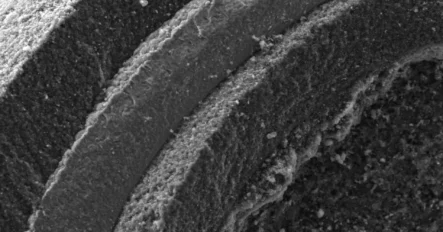
- Nuclear fission occurs in TRISO fuel particles: Energy is produced inside poppy-seed-sized uranium kernels sealed within protective ceramic layers and embedded in graphite fuel pebbles. Each TRISO particle’s ceramic layers are designed to retain fission products at temperatures far exceeding any foreseeable operating or accident scenario, providing containment at the particle level.
- Graphite absorbs heat and controls the reaction: The surrounding graphite, both in the pebbles and the core structure, slows neutrons to sustain a stable fission reaction and distributes heat evenly throughout the core.
- Helium carries heat out of the core: Helium gas flows through the reactor, picking up heat from the graphite. Because helium is inert and remains a gas across the full operating temperature range, it’s able to transfer heat without boiling, reacting, or corroding equipment.
Secondary Loop (Steam Generator)
- Heat passes through the steam generator: Hot helium flows into a steam generator where thermal energy passes through metal tubing into a separate water loop. The helium and water systems remain physically isolated, so only heat crosses the boundary – not radiation.
- Steam is used for power or industrial heat: The resulting steam can generate electricity through conventional turbines or be delivered directly to industrial facilities requiring high-temperature process heat—replacing fossil-fuel boilers without operational changes to existing manufacturing processes.
- Automatic shutdown if temperatures rise: If something disrupts normal operation, the Xe-100 is designed to shut down automatically. As fuel and graphite temperatures increase, the reactor experiences a strong negative temperature coefficient of reactivity. The resulting reduction in reactivity naturally decreases fission power until a new stable equilibrium is reached — without operator action or backup power.
A Global Legacy of HTGR Innovation
High-temperature gas-cooled reactors were born in the United States. The first commercial HTGR operated here. The most rigorous fuel qualification program in HTGR history was conducted here. And the operational lessons from American HTGRs — good and bad — have informed every design that followed.
But in its entirety, the story of HTGRs is one of global innovation: success, failure, refinement, and iteration over six decades of operational experience that has accumulated the second-largest body of operating experience for any commercial nuclear reactor technology besides LWRs:
- Peach Bottom (United States, 1966-1974): 40 MWe prototype reactor, 75% capacity factor, validated helium coolant and graphite moderation at commercial performance levels.
- Dragon (United Kingdom, 1964-1975): 20 MWth international research reactor, early TRISO fuel development and high-temperature operation demonstrations.
- Fort St. Vrain (United States, 1979-1989): 330 MWe commercial-scale prismatic HTGR, operated at 538°C outlet temperature, demonstrated exceptional radiological performance despite poor lifetime capacity factor.
- AVR (Germany, 1967-1988): 15 MWe experimental pebble-bed reactor, 21 years operation, validated passive safety through loss-of-forced-cooling tests.
- THTR-300 (Germany, 1985-1989): 300 MWe commercial-scale pebble-bed reactor, provided operational data at industrial scale, decommissioned due to post-Chernobyl political pressure.
- HTTR (Japan, 1998-present): 30 MWth high-temperature test reactor, currently operating, prismatic block design with 850°C coolant outlet capability.
- HTR-PM (China, 2021-present): First modern commercial HTGR, validated passive decay heat removal at commercial scale through full-power loss-of-cooling tests.
Following the shutdown of the THTR-300, German HTGR expertise, and HTGR designs more broadly, split in two directions: to China through formal technology transfer agreements, and to South Africa’s Pebble Bed Modular Reactor (PBMR) program. In 2012, X-energy founder Kam Ghaffarian recruited key figures from the PBMR leadership team — including Chief Engineer Eben Mulder and thermal-hydraulics expert Martin Van Staden — as X-energy’s first employees. Today, X-energy has grown from a small group of engineers working out of a one-room office in Greenbelt, Maryland, to one of the world’s leading developers of HTGR and TRISO fuel technology.
X-energy and the Xe-100
X-energy’s Xe-100 translates decades of global HTGR operational experience into a commercially-ready clean energy solution designed to meet the urgent need for safe, reliable power in three critical markets: grid-scale electricity, industrial heat & steam, and data center applications. Today, X-energy’s commercial pipeline stands at approximately 11 GW across the United States and United Kingdom, equivalent to 144 Xe-100 HTGRs.
The Xe-100’s commercial pipeline spans three distinct applications, each leveraging HTGR technology’s unique combination of high-temperature capability, intrinsic safety, and operational flexibility:
- Grid-Scale Electricity & Reliability
- Dispatchable clean baseload: 95% target capacity factor with load-following capability
- Siting flexibility: Small physical footprint (1/4 to 1/10 traditional nuclear) with 400-meter emergency planning zone enables brownfield sites, retired coal plants, and behind-the-meter deployment
- Reliable energy: 60-year anticipated operational life with continuous online refueling
- Industrial Process Heat & Decarbonization
- 565°C steam output: Enables industrial applications light-water reactors physically cannot serve (chemicals, refining, hydrogen, steel)
- Cogeneration capability: Delivers electricity and high-temperature process steam simultaneously, directly replacing fossil-fuel boilers
- 400m EPZ: Enables co-location at existing industrial facilities;
- Data Centers & AI Infrastructure
- Load-following for dynamic workloads: Ramp capability matches variable computing demand; 95%+ target availability for mission-critical uptime
- Scalable modular deployment: 80 MWe modules come online independently upon completion, matching load expansion to real-world demand growth.
- Minimal water usage: Air-cooled condensers minimize water usage, providing greater siting flexibility in water-scarce regions.
Xe-100: A New Solution for the Modern Economy
| Specification | Xe-100 |
| Power output per unit | 80 MWe (200 MWt) |
| Standard configuration | Four-or-twelve-unit plant (320 MWe / 960 MWe) |
| Steam outlet temperature | 565°C |
| Target availability | 95%+ |
| Anticipated Operational life | 60 years |
| Refueling | Continuous online refueling (no shutdown required) |
| Core configuration | Pebble-bed (~220,000 fuel pebbles per reactor) |
| Fuel type | TRISO-X (UCO TRISO particles in graphite pebbles) |
| Safety systems | ~1/6 of of safety-related systems vs. conventional LWR |
| Emergency planning zone (EPZ) | 400 meters |
Empowering the Unprecedented
For nuclear energy to reach its full potential, commercial technologies need to be able to look beyond conventional power generation. The reality of today’s economy is that nuclear energy has to do more. Grid operators managing peak demand need dispatchable generation that can respond to real-time conditions. AI and cloud computing are expanding rapidly, and straining outdated infrastructure. Industrial facilities that have relied on fossil fuels for decades need clean alternatives that can operate at the temperatures their processes require.
X-energy and the Xe-100 are ready to rise to the challenge. Sixty years of global innovation have produced a mature, proven technology built on real, tangible operational learnings, giving us a strong foundation for first-of-a-kind deployment, and a clear pathway to commercial scale.