
Bridging the Nuclear Language Barrier
Nuclear energy has a language problem. In part because of the complexity of the technology, innovation in the sector often gets buried under impenetrable jargon accessible to scientists, technicians, and industry insiders, and inaccessible to literally everyone else. Many of these phrases are largely outdated: academic shorthand that persists because it once described research concepts, not because it offers clarity about the commercial technologies approaching the market today. In today’s nuclear lexicon, few terms illustrate this disconnect more clearly than “Generation IV” reactors.
At X-energy, we believe innovative technology should be explained in clear, accessible terms that connect directly to real-world outcomes. Clean, safe, reliable energy shouldn't require a specialized vocabulary to understand. But because this particular term is used so frequently, we’ll translate what “Gen IV” originally meant — once — then move past the paper reactor to focus on the practical technologies, performance characteristics, and industrial applications that actually define new nuclear today.
What Is a “Generation IV” Nuclear Reactor?
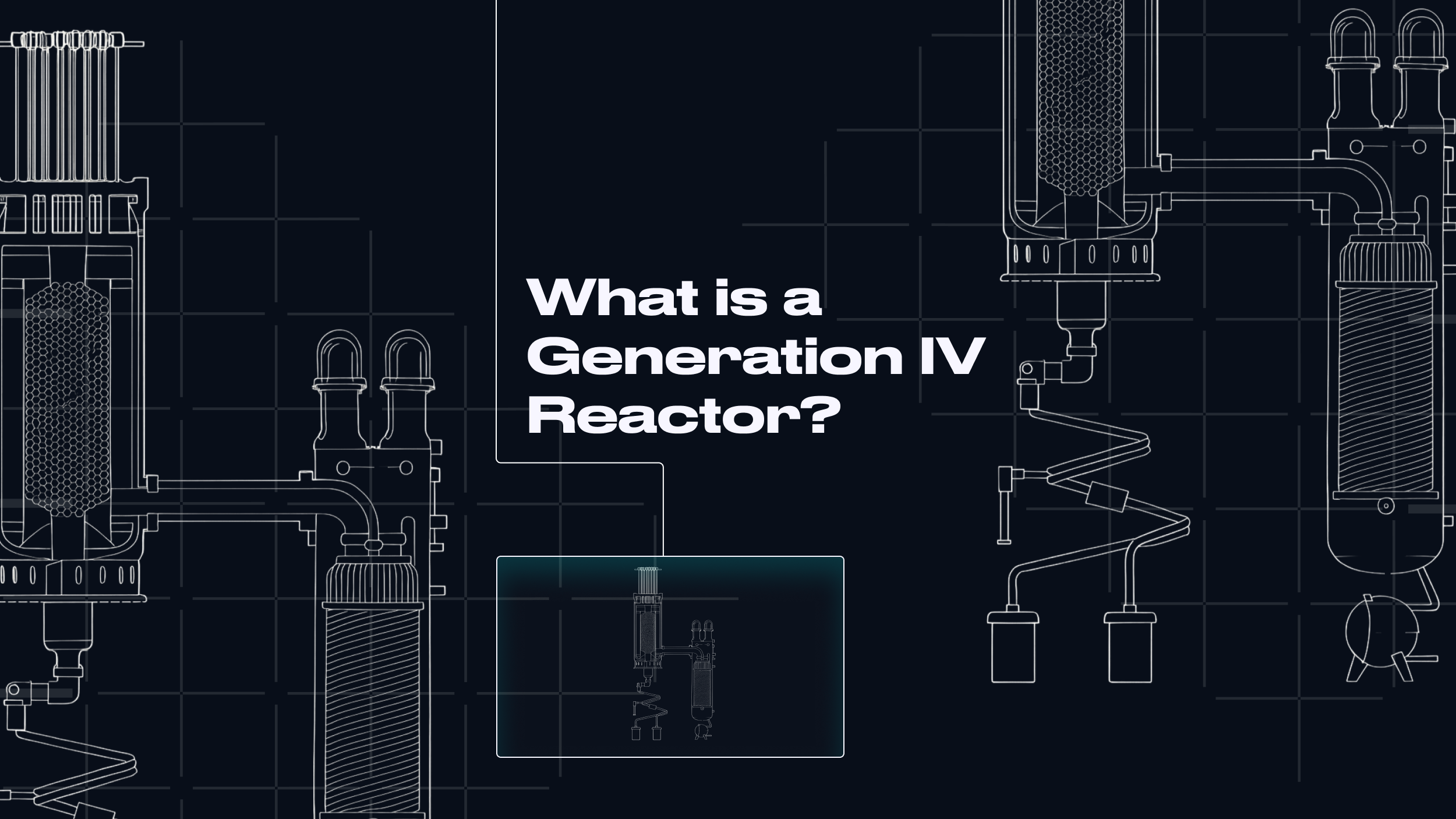
Generation IV nuclear reactors are a category of advanced reactor concepts established in the early 2000s by the Generation IV International Forum (GIF). The framework was created to explore advanced nuclear concepts that could improve efficiency, safety, sustainability, and nonproliferation relative to conventional light-water reactors.
The Generation IV framework was never intended to describe build-ready reactors or commercial products. Instead, it grouped conceptual designs around aspirational performance goals that could guide long-term research and development:
Higher thermal efficiency: Operating at significantly higher temperatures than conventional light-water reactors to convert a greater fraction of nuclear heat into usable energy.
Intrinsic safety: Relying on fundamental physics and material properties to ensure safe, stable operation without depending on mechanical systems, operator intervention, or backup power.
Fuel utilization: Extracting more energy from each unit of uranium through advanced fuel designs and higher burnup to improve resource efficiency and long-term fuel sustainability.
Reduced waste: Producing less spent fuel and making that fuel easier to manage over time by using nuclear material more efficiently.
These goals describe what researchers hoped advanced reactors could achieve, not whether those systems could be engineered, licensed, constructed, or operated at scale. Consequently, technologies grouped under the Gen IV label have progressed at very different rates.
The Original Generation IV Reactor Concepts
The Gen IV framework identified multiple reactor pathways that could, in theory, outperform earlier generations of nuclear technology by rethinking core design choices such as coolant type, neutron spectrum, fuel form, and operating temperature. Rather than refining existing light-water reactor designs, the Generation IV effort explored fundamentally different approaches, identifying six reactor concepts as promising candidates for long-term research and development:
Gas-Cooled Fast Reactors (GFR) use helium coolant with fast neutron spectrum.
Lead-Cooled Fast Reactors (LFR) operate with liquid lead or lead-bismuth coolant.
Molten Salt Reactors (MSR) utilize liquid salt either as coolant or fuel.
Sodium-Cooled Fast Reactors (SFR) employ liquid sodium as primary coolant.
Supercritical Water-Cooled Reactors (SCWR) use water above critical point.
Very-High-Temperature Reactors (VHTR) use helium coolant, and were designed for temperatures above 900°C.
The VHTR concept is today known as a High-Temperature Gas-Cooled Reactor (HTGR), building on earlier U.S. experience with the Peach Bottom prototype HTGR, which operated from 1967-1974, and the Fort St. Vrain Nuclear Generating Station, which operated as a commercial-scale HTGR from 1979 to 1989. While other Generation IV concepts remain largely experimental or pre-commercial, HTGRs advanced through fuel qualification, licensing, materials validation, and full-plant operation decades ago.
Inside the Xe-100: A Commercial Gen IV Reactor
The Xe-100 translates high-temperature gas-cooled reactor (HTGR) principles into a deployable commercial system, applying decades of reactor physics, materials validation, and fuel qualification in a modern, modular design.
Key Design Features of the Xe-100:
Reactor type: The Xe-100 is a High-Temperature Gas-Cooled Reactor (HTGR), using helium coolant, graphite moderation, and TRISO fuel to anchor safety in material behavior and physics.
Power and heat output: Each Xe-100 module produces approximately 80 megawatts of electricity (MWe) and delivers steam at temperatures up to ~565 °C, enabling a single system to meet both power and process-heat needs.
Industrial applicability: The high-temperature output makes the Xe-100 well suited for energy-intensive industries—such as chemicals, refining, cement, and steel—where emissions are difficult to abate through electrification alone.
Modular deployment: Xe-100 plants are designed for modular construction using standardized components, allowing factory fabrication, highway transport for all components, and on-site assembly to support simpler, repeatable builds.
Load following: The reactor is designed to adjust power quickly to meet real-time energy demand, using a highly automated control system that reduces operator burden while maintaining precise, reliable operation.
TRISO-X: The Xe-100 uses X-energy’s proprietary TRISO-X fuel, produced through X-energy’s domestic fuel program, supporting a secure and scalable advanced nuclear supply chain.
TRISO-X Fuel and the Advanced Nuclear Supply Chain
For high-temperature gas-cooled reactors like the Xe-100, fuel performance is critical to safety, economics, and scalability. X-energy’s answer is TRISO-X, a proprietary implementation of tri-structural isotropic (TRISO) particle fuel refined for commercial-scale deployment.
Fuel innovation, refined for scale: X-energy has operated a pilot facility at the Oak Ridge National Lab since 2016, building on decades of TRISO manufacturing experience to develop TRISO-X—a version optimized for higher manufacturing yields, tighter quality control, and repeatable production at commercial scale.
Secure domestic fuel supply: There is currently no commercial-scale TRISO fuel fabrication capability operating in the United States. To close this critical gap in the U.S. nuclear fuel cycle, X-energy produces its own TRISO-X fuel to help ensure consistent quality, predictable cost, and reliable supply.
TX-1 Fuel Fabrication Facility: X-energy is building TX-1, the United States’ first commercial-scale TRISO fuel fabrication facility, in Oak Ridge, Tennessee. TX-1 is designed to transition TRISO fuel from pilot production to industrial manufacturing, supporting Xe-100 projects and future advanced reactors with a secure, domestic fuel supply.
Paper to Projects: Gen IV in Today’s Commercial Market
From their academic origins more than a quarter-century ago, some Gen IV reactor concepts are now progressing beyond research and demonstration toward real-world application. For X-energy, that transition is taking shape through a set of projects that apply HTGR technology to industrial energy, AI applications, and grid-scale power across both the United States and United Kingdom.
Dow (Industrial Heat and Steam): X-energy’s initial deployment is a 4-unit plant planned for Dow’s UCC Seadrift Operations Site on the Texas Gulf Coast. The project is supported by the U.S. Department of Energy’s Advanced Reactor Demonstration Program (ARDP) and would make Seadrift the first industrial facility in North America powered by nuclear energy.
Amazon and Energy Northwest (AI Infrastructure, Grid Power): The 12-unit Cascade Advanced Energy Facility in Washington is intended to support both AI and data-center energy demand and firm, carbon-free electricity for the regional grid. It is the first of several Amazon and X-energy projects targeting at least 5 gigawatts of new nuclear by 2039.
Centrica (Electric & Industrial Energy): In the United Kingdom, X-energy has signed a 6-gigawatt Joint Development Agreement with Centrica to deploy the country’s first advanced reactor fleet. With a preferred first site in Hartlepool, the effort is focused on evaluating how HTGR technology can contribute to electricity generation and industrial energy needs as the UK modernizes its energy infrastructure.
Frequently Asked Questions
How are Gen IV reactors safer than older designs?
Advanced reactors like the Xe-100 rely on intrinsic safety features. These include meltdown-resistant TRISO-X fuel, passive cooling systems that that can remove decay heat without the need for active cooling (i.e. pumps which require electricity), and physics which shut down the reactor down naturally without requiring active system or operator action to ensure safety.Do these advanced reactors still produce nuclear waste?
All nuclear technologies generate some form of spent fuel. However, modern reactors like the Xe-100 are more fuel-efficient, producing less waste per unit of electricity generated. TRISO-X fuel also locks in fission products at the particle level, simplifying handling and long-term storage.Why is high-temperature heat so important?
Heavy industries—chemical manufacturing, steel, refining—require superheated steam for their processes. Advanced reactors like the Xe-100 can provide up to 565°C steam, directly displacing fossil-fueled boilers and reducing carbon emissions. High-temperature heat is also important electricity generation, with the Xe-100’s higher steam temperature also increasing the efficiency with which electricity is produced.Are Gen IV reactors more expensive than traditional large reactors?
They aim to be less expensive. Smaller modular designs factory fabrication, and highly repeatable builds help to reduce capital costs and construction timelines compared to large, conventional plants. Tax incentives, such as those in the U.S. Inflation Reduction Act, further improve the economic outlook.Can advanced nuclear reactors be sited on old coal plant sites?
Yes. Small modular reactors (SMRs) and advanced reactors often fit on retired coal sites, leveraging existing water rights, grid connections, and local workforces—saving anywhere from 15–35% in construction costs, according to U.S. Department of Energy estimates.